

서울반도체 바이오레즈 기술을 활용한 코로나19 바이러스 살균 전후 사진 비교
서울반도체가 자사 광반도체 바이오레즈(violeds) 기술이 30초 만에 코로나19 바이러스의 99.9%를 살균했다고 2일 밝혔다.
서울반도체는 고려대 연구팀 실험에서 바이오레즈 빛(Photon)을 30초 비추자 코로나19 바이러스가 99.9% 살균됐다고 말했다. 회사에 따르면 바이오레즈 빛과 가깝고 노출 시간이 길수록 살균력이 높았다. 이어 바이오레즈가 대장균, 황색포도상구균, 녹농균, 폐렴균 등을 99.9% 살균할 수 있다고 설명했다.
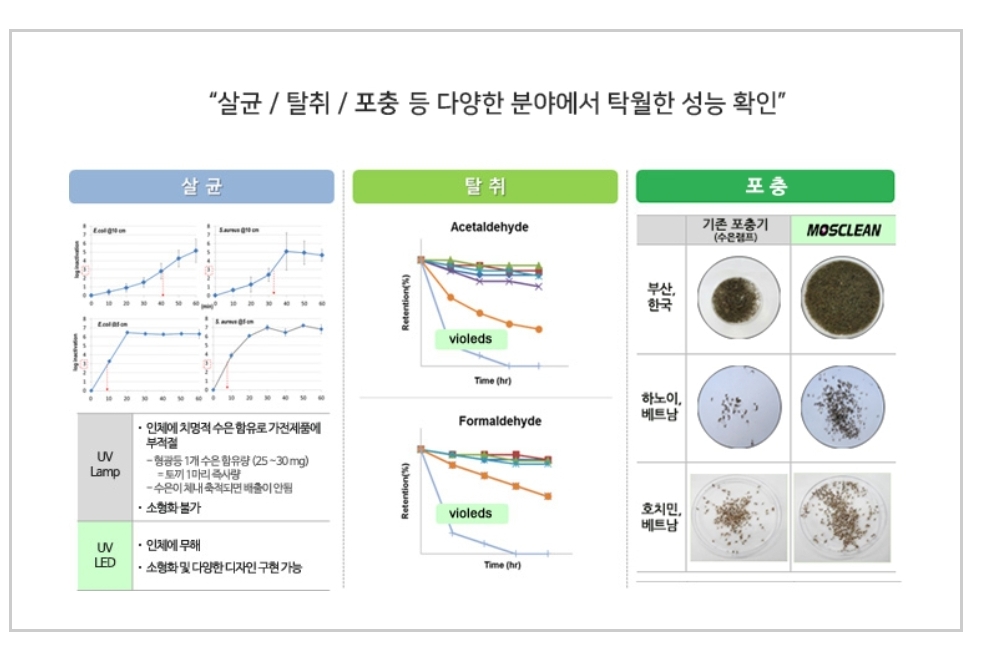
바이오레즈는 자외선(UV) 발광다이오드(LED)를 사물에 비추거나 LED 칩을 공기정화 시스템에 장착해 박테리아 등 유해균을 살균하는 기술이다. 응용제품에 따라 공기청정 및 탈취, 수질정화, 피부질환 치료, 경화 등에도 활용할 수 있다.
바이오레즈는 서울반도체 계열사인 서울바이오시스가 자회사인 미국 세티와 지난 2005년부터 개발했다. UV LED를 응용해 인체에 유해한 화학성분 없이 빛으로 세균 발생과 증식을 막을 수 있다. 그간 바이오레즈는 수명이 짧아 상업용 적용이 제한됐지만 지난해 수명을 5만 시간으로 늘렸다. 회사는 지난해 하반기부터 공기정화와 물 살균 제품 등에 공급하기 시작했다.
서울반도체는 "바이오레즈가 코로나19를 직접 살균할 수 있다는 점이 입증됐다"며 "공기청정기나 공조기, 냉장고 등에도 바이오레즈 활용이 가능해졌다"고 밝혔다.
조사시간에 따른 신종 코로나바이러스 살균력
ㅡㅡㅡ
서울바이오시스, 美 UV LED 기업 상대 특허소송 승소
법원, 해당 제품 영구 판매금지 판결
이성진 기자입력 2019-12-05
서울반도체 회사 전경. ⓒ서울반도체
▲ 서울반도체 회사 전경. ⓒ서울반도체
서울바이오시스 자회사 글로벌 UV LED 전문기업 세티는 미국 볼브와 퀀텀에그를 상대로 캘리포니아 북부지방법원에 제기한 특허침해 소송에서 최근 승소했다고 5일 밝혔다. 법원은 해당 제품에 대한 영구 판매금지를 명령했다.
이번 판매금지 명령은 소송에 피소된 특허침해 제품 뿐만 아니라 이와 유사한 특허를 사용하는 제품에 대해서도 적용된다.
볼브는 세티에서 근무하던 기술개발 엔지니어들을 영입해 설립한 UV LED 제조회사로, 관련 응용제품을 생산하는 퀀텀에그와 협력해 UV LED 시장 진출을 시도해왔다. 볼브가 침해한 세티의 5개 특허기술은 460~470㎚ 파장의 청색 LED보다 짧은 파장의 구현을 가능하게 하는 에피층성장, 칩 제조 등을 포괄하는 기술을 비롯해 UV LED 살균기 응용기술도 포함하고 있다.
violeds 기술의 우수성
violeds 기술은 차세대 UV 시장을 주도하는 혁신적인 기술입니다.
Seoul Viosys proves 99.9% sterilization of COVID-19 in 30 seconds
Choi Hee-seok and Minu Kim 기자
입력 2020.04.03 09:05
347221 기사의 0번째 이미지
[Source: Seoul Viosys Co.]
Seoul Viosys Co., a subsidiary of South Korea’s leading light emitting diode (LED) developer Seoul Semiconductor Co., announced on Thursday that its compound semiconductor technology successfully achieves 99.9 percent sterilization of COVID-19 in 30 seconds.
The Korean UV LED solution provider said tests were conducted by its U.S. affiliate Sensor Electronic Technology (SETi) in cooperation with a Korea University research team by using its compound semiconductor Violeds technology.
In the study, Violeds technology was used to show just how strong the sterilization effect can be on COVID-19 when exposed to Violeds photons for 30 seconds. This is the world’s first test to demonstrate photonic sterilization of COVID-19.
The study also found the coronavirus became even more sterile when placed closer to the photon with longer exposure time. The Violeds technology has already proved to be successful in sterilizing 99.9 percent of harmful bacteria such as E. coli, staphylococcus aureus, pseudomonas aeruginosa, and pneumococcus, according to Seoul Viosys.
Seoul Viosys said that this study proved Violeds technology can directly sterilize COVID-19, suggesting its applicability in various electronic devices such as air cleaners, air conditioners, and refrigerators. The technology is expected to contribute to preventing the spread of COVID-19 around the world, the company said.
On Friday, Seoul Viosys stock jumped 29.74 percent to 12,650 won, as of 09:12 a.m.
This website uses cookies to ensure you get the best experience on our website. View our privacy policy
Got it!
Laser Focus World
HOME
LASERS & SOURCES
Seoul Viosys sees increased demand for its UV LEDs for sterilization to prevent spread of coronavirus
Probably due to COVID-19, inquiries for the UV LEDs have increased by more than five times in a month.
John Wallace
Mar 3rd, 2020
Artist's depiction of the coronavirus COVID-19 at large.
Artist's depiction of the coronavirus COVID-19 at large.
Seoul Viosys
Seoul Viosys (Ansan, South Korea), a subsidiary of Seoul Semiconductor that produces UV LEDs, says that customer inquiries for its violeds UV LED products, used for sterilizing bacteria, increased more than five times over the previous month, fueled by concerns over the continuing global spread of the coronavirus (COVID-19).
According to the Ultraviolet Germicidal Irradiation Handbook,1 one minute of UV-C light sterilizes more than 90% of [other versions of] the coronavirus. Tests conducted by Chinese agencies on appliances equipped with violeds UV LED sterilization have demonstrated a 97% reduction in airborne virus particles.
With the growing concerns over the global spread of the coronavirus, numerous automotive companies in China are reviewing adoption of the violeds UV LED technology in sterilization systems for vehicle interiors.
Other uses
The violeds UV LEDs are also used by NASA aboard the International Space Station (ISS) to provide a germ-free environment for astronauts. In addition, the technology has been adopted by Maltani, a Korean lighting company, for sterilization lighting applications, and by RGF Environmental Group, an in-duct air treatment supplier in the U.S., for its Halo-LED indoor air-quality system launched in November of 2019. Violeds UV LEDs are also used in water purifiers from SK Magic and Hyundai Rental Care.
Conventional UV LEDs typically have a short lifetime (10,000 hours) and high cost, says Seoul Viosys. The company says that it has improved the lifetime of its own violeds UV LED to more than 50,000 hours, which is a lifetime similar to that for visible LEDs used for general lighting applications.
“We have long been involved in developing UV LEDs for innovative biomedical and agricultural applications,” says CEO Chung Hoon Lee, CEO of Seoul Semiconductor, which established Seoul Viosys 20 years ago. Seoul Viosys is currently run by its CEO Young Joo Lee, who started the company in 2002.
Source: Seoul Viosys
Diamond-'' Raman laser could have higher power and efficiency for telescope adaptive optics
John Wallace
Apr 3rd, 2020
Coherent has designated its fiber-laser operation in Tampere, Finland a “Center of Excellence for Fiber Lasers.” Products including Coherent's HighLight series of fiber lasers will be produced at the center. This figure shows the modular architecture of the Highlight FL series (left) and cuts by a Highlight FL through 1.25 mm brass and 1.2 mm copper (
Osram Opto Semiconductors blue high-power laser has use in stage lighting
Laser Focus World Editors
Mar 31st, 2020
Leibniz
Lasers & Sources
Quantum-entangled photons at 2.1
What Is a Digital Microscope?
Learn about what a digital microscope is, explore how it works, see the benefits of using one, and understand some of its applications.
Mar 11th, 2020
Covid Company Responses
Optics
Optics/photonics business statements on COVID-19 show grit in the face of adversity
Laser Focus World's compiled list of links to optics/photonics company, university, and other institutions' statements on COVID-19 shows that safety is paramount, and the industry is crucial to solving pandemic problems.
John Wallace
Mar 26th, 2020
Nanofabrica Roundtable
Lasers & Sources
Nanofabrica hosting roundtable 3/25 on using additive manufacturing to fight COVID-19
The company's 3D printing, with 1 μm resolution over cm-sized volumes, can make microfluidic chips and other essentials to fight COVID-19.
John Wallace
Mar 24th, 2020
John Lewis 720
Commentary
Mobile spectroscopy
The promise of spectroscopic sensors in smartphones and other portable devices may offer tremendous benefits to society, making it easier for farmers to improve the growing process and for consumers to better understand what they are eating.
John Lewis
Mar 24th, 2020
John Lewis 720
Photonics Business
Operating amidst uncertainty
The 32nd Lasers & Photonics Marketplace Seminar showed that the revenue numbers remain good for lasers and across many photonics markets, but will depend on geopolitical uncertainties such as trade tariffs and the ongoing impact of the COVID-19 virus.
John Lewis
Mar 24th, 2020
2003 Lf Wnb Z04
Detectors & Imaging
Basic monocular camera and LED-based communication enables autonomous vehicle-to-vehicle positioning
Because GPS is prone to interference errors and lidar is expensive, a basic monocular camera and LED-based visible light communication is a lower-cost, more sensible option to accomplish autonomous vehicle-to-vehicle positioning.
Gail Overton
Mar 24th, 2020
2003 Lf Wnb Z03
Lasers & Sources
Octave-spanning CW supercontinuum laser has a 72 W optical output
Two spectrally combined fiber laser pumps are combined with standard single-mode fiber to produce a high-power supercontinuum laser with a 44% conversion efficiency.
John Wallace
Mar 24th, 2020
The amount of electrical current produced in a GaAs device as a function of the frequency of the surface acoustic wave (SAW) driving the LDW peaks at the 1.163 GHz resonant frequency of the SAW (top). At the point where the electrons cross an n-i-p junction in the GaAs, an LED is formed; the number of photons produced (intensity count) of the LED as a function of SAW frequency corresponds well with the electrical current (center). The energy spectrum of the electroluminescence from the LED has an energy peak at 1.531 eV with a full width at half maximum (FWHM) of 1 meV (bottom).
Lasers & Sources
Acoustically driven electrons in an LED produce single photons
Surface acoustic waves in semiconductor produce moving quantum dots that carry electrons across a junction to emit photons, potentially allowing conversion between electron and photon qubits.
John Wallace
Mar 24th, 2020
In vivo single-plane images of green fluorescent protein (GFP)-labeled microglial cells in zebrafish are dramatically improved when imaged with a multiphoton video-rate microscopy (VMS) system from Bliq Photonics without (a) and with (b) an axicon module that incorporates a Spark Laser Alcor fiber laser at 920 nm. For the same scanning time, the axicon module expands imaging depth of field and improves contrast. Scale bar is 20 µm.
Lasers & Sources
Femtosecond fiber laser at 920 nm improves two-photon microscopy imaging
Imaging depth, focus, and contrast is greatly improved in two-photon microscopy applications using a compact 920 nm, 4 W, 100 fs pulse-width fiber laser.
Gail Overton
Mar 24th, 2020
In this sketch of an intense laser pulse interacting with a microchannel plasma (MCP) target, the pulse propagates from right to left (green balls and red fringes represent electrons and the incident laser light, respectively; green and red arrows indicate the direction of movement of electrons and the laser). The MCP target consists of a channel with a length of 15 μm and a diameter of 6 μm attached to a 5-μm-thick substrate.
Lasers & Sources
Circularly polarized laser-driven plasma produces gamma rays with orbital angular momentum
Simulations show that a circularly polarized ultrafast petawatt laser beam irradiating a microchannel structure can produce gamma rays with orbital angular momentum for physics research.
John Wallace
Mar 24th, 2020
Conard 720
Commentary
Developing new markets with dual-use technology—An interview with Gregory Quarles
An interview with Gregory Quarles, CEO of Applied Energetics, shows a company with multiple-use applications based on directed energy and ultrashort-pulse lasers.
Conard Holton
Mar 24th, 2020
FIGURE 1. An adaptive laser micromachining process operates in a way similar to an optical coherence tomography (OCT) measurement (a). The f-theta lens is seen inside the micromachining setup (b). A carbide drill with an undercut fabricated using adaptive microdrilling has a depth accuracy more accurate by a factor of about five in comparison to if it were made via a nonadaptive laser process (c).
Optics
F-theta lenses keep laser-scanning nice and linear
F-theta lenses have a laser spot position linearly proportional to the scan angle and are thus useful in many laser-scanning applications.
John Wallace
ㅡㅡㅡㅡ
Demand increase for disinfecting UVLEDs from Seoul Viosys
05 Mar 2020
UV LED “Violeds” being used for sterilization applications to stem spread of coronavirus, says Korean firm.
RGF’s air conditioning system with Violeds technology.
Seoul Viosys, a developer of UV LED technology and a subsidiary of Seoul Semiconductor, announced this week that customer inquiries for its Violeds UV LED products, which can be used for sterilizing bacteria, increased more than five times over the previous month, fueled by concerns over the continuing global spread of the coronavirus (Covid-19).
With growing concerns over the global spread of the coronavirus, numerous automotive companies in China are actively reviewing adoption of Seoul’s violeds UV LED technology in sterilization systems for vehicle interiors, it adds. Violeds UV LED technology has also been used by the US National Aeronautics and Space Administration (NASA) aboard the International Space Station (ISS) to provide a healthy, germ-free environment for astronauts.
For example, Seoul’s violeds UV LED technology has been adopted by Maltani, the largest Korean lighting company, for sterilization lighting applications, and by RGF Environmental Group, an in-duct air treatment supplier in the U.S., known for its Halo-LED indoor air quality system, launched in November of 2019.
Until recently, many companies have been conservative in their adoption of UV LED technology, says the company, "because conventional UV LEDs typically had a short lifetime (10,000 hours) and high cost." However, Seoul Viosys has improved the lifetime of its violeds UV LED to more than 50,000 hours, similar to visible LEDs used for general lighting applications, and increased production capacity to achieve cost competitiveness.
“Seoul Viosys is committed to developing technology that protects human health and creates a cleaner world, and we have long been involved in developing UV LEDs for innovative biomedical and agricultural applications,” commented CEO Chung Hoon Lee, CEO of Seoul Semiconductor, which established Seoul Viosys 18 years ago to develop UV-LED technology in strategic partnerships with Japanese and U.S. companies.
“Through innovation, sustained research and development, and manufacturing experience, we were able to improve the lifetime of UV LEDs up to 50,000 hours and significantly reduce product cost. We hope that Seoul’s violeds UV LED technology will help protect human health and create a cleaner world in the face of the current health situation.”
Seoul Viosys’ claims
“Violeds UV LED sterilization technology has been demonstrated to reduce influenza-type germs by 97 per cent.”
“60 seconds of UV-C (100 – 280nm) LED light exposure has been shown to sterilize 90 per cent of coronavirus germs.”
“Automakers in China are actively exploring Violed UV LED technology for vehicle interior sterilization systems.”
“Seoul’s Violeds UV LED sterilization technology has been deployed by NASA on board the International Space Station.”